
The 1983 draft tops our ranking of the greatest NFL draft classes of all time. John Elway, Dan Marino and Jim Kelly give it three Hall of Fame quarterbacks. Eric Dickerson, Bruce Matthews, Darrell Green and Richard Dent make the argument much bigger than quarterback alone. The 1964 and 1957 classes follow, with talent spread across positions and deep into the draft.
We're comparing entire draft years across the league. The order reflects our judgment about career greatness and depth, supported by the Pro Football Hall of Fame's draft records. The player selections are facts. Deciding whether 1985 belongs above 1996 is where the debate starts.
Key takeaways
- The 1983 class ranks first for its combination of quarterbacks, other leading players and talent beyond round one.
- The 1964 and 1957 classes deserve a place near the top even when the comparison includes modern stars.
- Draft position matters to the discussion. Richard Dent went 203rd, Terrell Owens 89th and Richard Sherman 154th.
- The downloadable reference covers 48 selected players, with rounds, overall picks and official sources. It is a curated set of examples from these ten classes.
How we ranked the greatest NFL draft classes
We considered the players' best seasons, the strength of the class across positions and the quality available after the first round. A class with a great quarterback and little else has a different case from one that supplied leading players on both lines and throughout a defense.
Career achievements follow the player across teams. A franchise losing a player later does not erase his contribution to that draft year's talent. Selection year also stays separate from rookie year, which matters for Roger Staubach: Dallas drafted him in 1964, and he began his NFL playing career in 1969.
The scope includes players selected in the annual NFL draft and, from 1967, the common AFL-NFL draft. For earlier years, we count each NFL selection once. Separate supplemental drafts and undrafted signings are outside this ranking.
Era affects the comparison. Older drafts could run well beyond today's later rounds, and passing statistics come from different offensive environments. Hall of Fame totals also favor players whose careers and eligibility periods have finished. Those details inform the order, without producing a numerical score that pretends to settle it.
The facts were checked on October 27, 2026. Every rank below is DreamDraft's editorial choice.
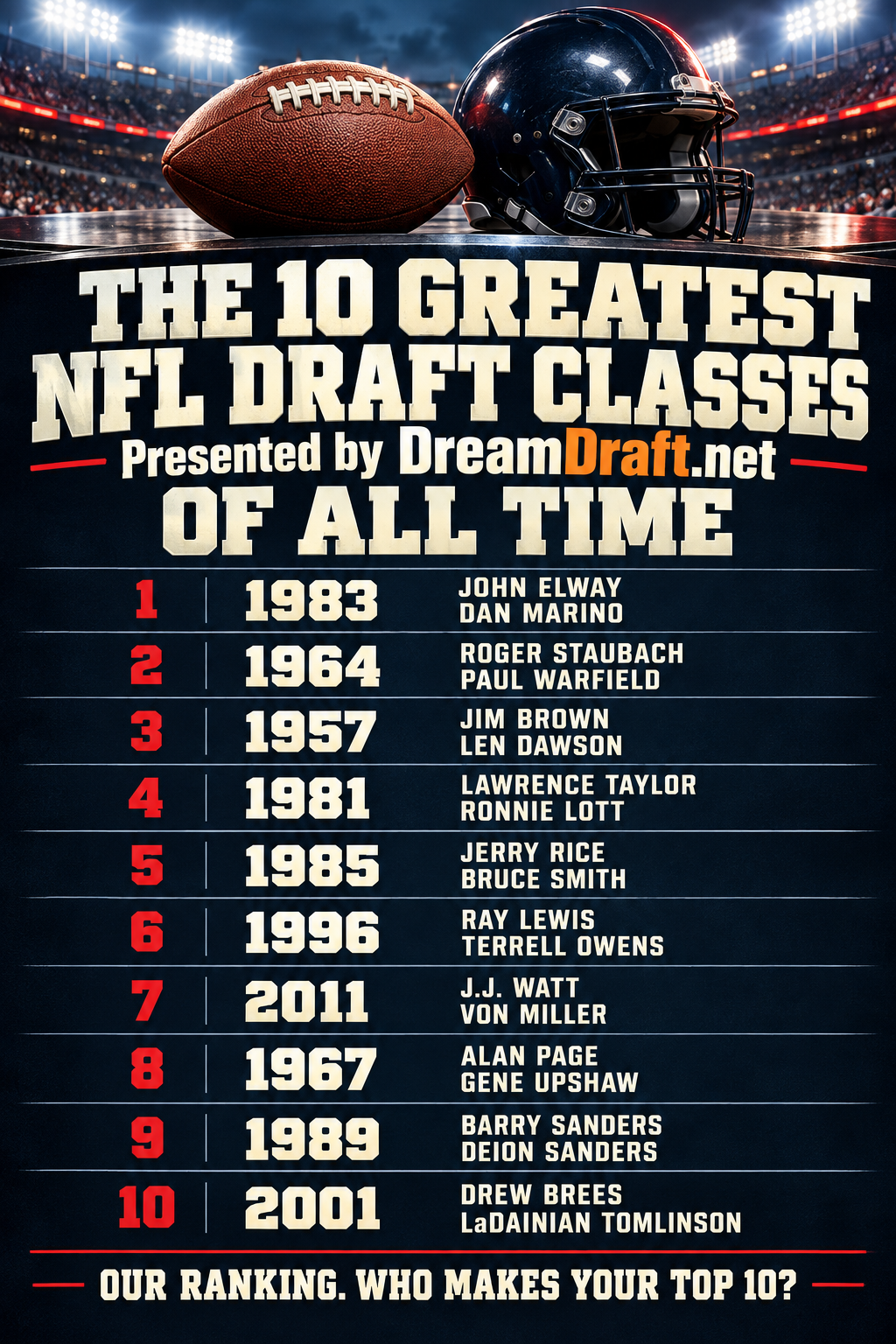
The ten best NFL draft classes at a glance
| Rank | Draft year | Selected standouts | A pick beyond round one |
|---|---|---|---|
| 1 | 1983 | John Elway, Dan Marino, Jim Kelly, Eric Dickerson | Richard Dent, round 8, pick 203 |
| 2 | 1964 | Roger Staubach, Paul Warfield, Mel Renfro, Bob Hayes | Staubach, round 10, pick 129 |
| 3 | 1957 | Jim Brown, Len Dawson, Jim Parker, Sonny Jurgensen | Don Maynard, round 9, pick 109 |
| 4 | 1981 | Lawrence Taylor, Ronnie Lott, Mike Singletary, Howie Long | Russ Grimm, round 3, pick 69 |
| 5 | 1985 | Jerry Rice, Bruce Smith, Andre Reed, Kevin Greene | Greene, round 5, pick 113 |
| 6 | 1996 | Ray Lewis, Terrell Owens, Marvin Harrison, Zach Thomas | Thomas, round 5, pick 154 |
| 7 | 2011 | J.J. Watt, Von Miller, Julio Jones, Cam Newton | Richard Sherman, round 5, pick 154 |
| 8 | 1967 | Alan Page, Gene Upshaw, Willie Lanier, Bob Griese | Ken Houston, round 9, pick 214 |
| 9 | 1989 | Barry Sanders, Deion Sanders, Derrick Thomas, Troy Aikman | First-round strength leads its case |
| 10 | 2001 | Drew Brees, LaDainian Tomlinson, Richard Seymour, Steve Hutchinson | Steve Smith Sr., round 3, pick 74 |
Download the ranking table as CSV or get the 48-player selection reference. Each player row in the larger file includes its original source.
1. 1983: The quarterbacks are only the start
Elway went first overall, Kelly 14th and Marino 27th. Three Hall of Fame quarterbacks came from one first round of the 1983 draft.
Marino's 1984 MVP season brought 5,084 passing yards and 48 touchdowns. Elway later won consecutive Super Bowls. Their careers give the class both extraordinary individual performance and championship success, without making a title the only test of a quarterback.
Then add Dickerson, Matthews and Green. Dent lasted until round eight, 203rd overall. That range is what keeps 1983 first for us: the argument still works after you stop talking about the quarterbacks. The best challenge comes from the breadth of the next two classes, rather than a shortage of stars here.
2. 1964: Great players kept appearing in later rounds
The 1964 class offers one of the strongest arguments for moving 1983 down. Paul Warfield went 11th overall, Mel Renfro 17th and Bob Hayes 88th. Roger Staubach was still available at pick 129 in the tenth round.
Staubach's timeline needs care. His selection belongs to 1964, but his NFL playing career began in 1969 after Navy service. He went on to lead Dallas to victories in Super Bowls VI and XII. Grouping players by debut season would put him in the wrong draft class.
Bob Brown, Charley Taylor, Carl Eller, Paul Krause, Dave Wilcox and Leroy Kelly extend the list. We put 1964 second because of that broad supply of accomplished players. The 1983 quarterbacks carry more weight in our order, but a ranking that gives positional breadth greater emphasis could reasonably reverse the top two.
3. 1957: Jim Brown leads an unusually deep class
Jim Brown is the obvious starting point. He led the NFL in rushing in eight of his nine seasons, a level of sustained dominance that makes the sixth overall pick a defining selection.
The 1957 draft also included Len Dawson, Jim Parker and Sonny Jurgensen. Jurgensen went in round four at pick 43; Don Maynard lasted until round nine at 109. Brown's presence should not make the rest of that group disappear from the comparison.
Brown's eight rushing titles put 1957 ahead of 1981 for us. Dawson, Jurgensen, Parker and Maynard give it a case beyond its best player.
4. 1981: Start building the defense here
Lawrence Taylor and Ronnie Lott went second and eighth overall. Taylor later won league MVP in 1986, recording 20.5 sacks that season. A draft that supplied those two would already demand attention.
The second round adds Mike Singletary, Howie Long and Rickey Jackson. Russ Grimm followed in round three.
Taylor, Lott, Singletary, Long and Jackson make 1981 our first choice for building a defense. Its relative weakness at quarterback keeps it fourth.
5. 1985: Jerry Rice and Bruce Smith, with more behind them
Jerry Rice finished with 1,549 catches, 22,895 receiving yards and 197 receiving touchdowns. Bruce Smith recorded 200 career sacks. Their presence makes the peak of the 1985 class difficult for almost any year to match.
The draft record also includes Chris Doleman, Andre Reed and Kevin Greene. Reed went in the fourth round at pick 86; Greene arrived in the fifth at 113. The best names were spread across the draft, with Smith first overall and Rice 16th.
Fifth is a close call. If the question gives the greatest individual careers most of the weight, 1985 can move up. We prefer the broader defensive group from 1981 just ahead of it. Reed and Greene are the reason the case for 1985 remains strong when the discussion moves beyond Rice and Smith.
6. 1996: Receivers, defenders and value outside round one
Ray Lewis, Marvin Harrison and Jonathan Ogden arrived in the first round. Lewis became a two-time AP Defensive Player of the Year and Super Bowl XXXV MVP. That would be an excellent starting group for any class.
Brian Dawkins went in round two. Terrell Owens went 89th overall in round three, and Zach Thomas 154th in round five. Those 1996 selections show how much talent remained after the initial picks.
Owens finished with 15,934 receiving yards and 153 receiving touchdowns. Pair that career with Harrison's and the class has a strong receiving argument before its defenders enter the discussion. We put it sixth because it balances accomplished stars and later selections so well. There is a defensible case for putting it above 1985; our order gives Rice and Smith's individual careers the edge in that comparison.
7. 2011: A modern class that keeps this debate open
The first round of the 2011 draft included Cam Newton, Von Miller, A.J. Green, Patrick Peterson, Julio Jones, J.J. Watt and Tyron Smith.
Newton became the 2015 league MVP. Watt won Defensive Player of the Year three times. Seattle found Richard Sherman in the fifth round at pick 154, so the case extends beyond its famous first round.
The pass rushers, receivers and defensive backs put 2011 seventh for us. The years above it have a stronger combined case on achieved careers, particularly at quarterback. Watt, Newton and Sherman make the 2011 argument without any projected future honors.
8. 1967: The first common draft supplied talent across the field
The first common AFL-NFL draft took place in 1967, following the leagues' merger agreement. That makes it a useful dividing point when comparing draft years across eras.
Bob Griese went fourth overall, Alan Page 15th and Gene Upshaw 17th. Willie Lanier followed in round two. Page later won league MVP in 1971, giving the class an individual achievement rarely associated with a defensive tackle.
Ken Houston lasted until the ninth round, pick 214, in the same draft. Griese and Upshaw cover two major offensive roles, while Page, Lanier and Houston give it strength at each level of the defense.
9. 1989: Four remarkable names in the first five picks
Troy Aikman went first overall. Barry Sanders, Derrick Thomas and Deion Sanders followed at three, four and five. All four became Hall of Fame players. The 1989 draft record is unusually striking right at the top.
Barry Sanders finished with 15,269 rushing yards in ten seasons, including 2,053 in 1997. Steve Atwater, selected 20th overall, adds another major defensive name later in the first round.
Ninth may be the placement readers challenge most. This class has a powerful case if the leading few players decide the order. Our comparison also gives substantial weight to what the rest of a draft contributes, which favors several of the years above it.
10. 2001: Brees, Tomlinson and enough depth to take the last spot
LaDainian Tomlinson went fifth overall and Drew Brees 32nd, in the second round. Richard Seymour and Steve Hutchinson add high-level line play to the 2001 class.
Tomlinson won league MVP in 2006 after scoring 31 touchdowns. Steve Smith Sr., a third-round pick at 74, finished with 14,731 receiving yards. That receiving contribution matters when weighing the class beyond its quarterback and running back.
Brees and Tomlinson's achieved careers are central to our choice for tenth. Seymour, Hutchinson and Smith give it enough support to survive a close comparison with the omitted years. This final place is an editorial call, particularly against 1968, whose strength across the lines gives it a serious alternative case.
Which great draft classes just missed?
The 1968 class, with Ken Stabler, Larry Csonka, Ron Yary and Art Shell, is the closest older alternative. There is no large separation between that group and the final few years in our ten.
The 2004 class becomes especially persuasive when quarterback career value gets more weight. Eli Manning, Philip Rivers and Ben Roethlisberger came from that year, alongside Larry Fitzgerald and Jared Allen.
For 2007, start with Calvin Johnson, Adrian Peterson, Joe Thomas, Darrelle Revis and Patrick Willis. Those are substantial omissions from a top ten, which is why the ranking needs its criteria stated. Moving one year in also means deciding which listed class moves out.
Watch the players talk about their draft years
Dan Marino and Jim Kelly appeared together on the Dan Patrick Show to talk about their friendship and the Dolphins-Bills rivalry. Their shared draft year makes the conversation a useful companion to the 1983 section. NBC Sports also carries a clip of them recalling the 1983 draft.
Dan Marino and Jim Kelly join Dan Patrick to discuss their friendship and the Dolphins and Bills rivalry.
Watch on YouTubeBarry Sanders joined the Rich Eisen Show for a conversation about a different possible draft destination: Green Bay. It adds a player's perspective to the 1989 selections discussed above.
Barry Sanders joins Rich Eisen to discuss his draft destination and the possibility of playing for Green Bay.
Watch on YouTubeDownload the ranking and player-selection data
The ranking CSV contains the ten places, years and representative selections shown in the overview. The 48-player CSV adds each selected player's position, round, overall pick, original source and check date.
These files are a reference for checking the examples and building your own comparison. The larger file covers selected players rather than every pick from all ten drafts. Its row counts cannot be used to calculate a class's overall hit rate or its share of successful later-round picks.
Keep the source links with any rows you reuse, and cite this article for DreamDraft's editorial order. The ranking graphic is also available to download.
Frequently asked questions
What is the greatest NFL draft class of all time?
We rank 1983 first. Its three Hall of Fame quarterbacks, John Elway, Dan Marino and Jim Kelly, lead a group that also includes Eric Dickerson, Bruce Matthews, Darrell Green and Richard Dent. The 1964 and 1957 classes are our closest challengers.
Does a draft class mean one team's picks or the whole year?
It can mean either, so the scope needs to be stated. This article ranks all players selected across the league in a particular annual draft. A ranking of one franchise's draft haul answers a different question.
Is the 2011 NFL draft class better than 1983?
Our ranking puts 1983 ahead, with 2011 seventh. The 2011 class has exceptional defensive and receiving talent, plus Cam Newton at quarterback. We give more weight to the combined quarterback careers and depth of 1983. Readers who emphasize pass rushers and receivers can make a different case.
Do undrafted players count in these rankings?
This list includes drafted players only. Undrafted signings and separate supplemental drafts are excluded. That keeps the comparison tied to the selections made in each annual draft.
How do longer older drafts affect the comparison?
More rounds create more chances to select a future contributor. A round number also represents different numbers of overall picks in different eras. The reference includes both round and overall selection so readers can see that context, rather than treating every fifth-round pick as an identical opportunity.
Why not rank recent classes by their likely Hall of Famers?
Projected honors have not happened yet. We use achieved careers and completed awards, while recognizing that active players can change the comparison. Hall induction also requires time after retirement, so a low present-day Hall total is an incomplete measure of a newer class.
Build your own all-time football roster
The ranking is our call. Your roster can reflect a different view of football's best players. Start a DreamDraft football draft, choose a Year Draft for a single season, or try the Football Daily Challenge. Finished eligible rosters appear on the football leaderboards.
Sources
- Pro Football Hall of Fame draft records for 1957, 1964, 1967, 1981, 1983, 1985, 1989, 1996, 2001 and 2011.
- Individual Hall of Fame career records linked beside the relevant claims, plus the Browns' Jim Brown history, Seahawks' all-time draft selections and Panthers' second- and third-round selections.
- NFL's report of J.J. Watt's third Defensive Player of the Year award and the Packers' oral history of the first common draft.
- Original interviews from the Dan Patrick Show and Rich Eisen Show, with Dan Patrick's episode page and NBC Sports' draft clip.